Friday, 19 June 2020

Beta's colander


Buy SWHF Stainless Steel 5 L Jumbo Colander and Strainer Online at ...
This is a classic titanic post, because (as so often) I don't really know what I'm talking about. Through the lockdown I made a half-hearted attempt to learn R, the leading statistical programme. As usual, what caught my eye was an ancient Greek. 

Specifically, Eratosthenes of Cyrene. Eratosthenes is one of the great figures of Hellenistic Alexandria. He was head of the library there, the highest intellectual position of the day. He's best remembered today for estimating the circumference of the earth to an astounding degree of accuracy, but he was also a polymath interested in literature, music, and, as we'll see, mathematics. He was called 'Beta' by his peers, not because he was on Reddit, but because he was the second best at everything.

Not too far into my studies in R, I came across Eratosthenes' sieve, a simple algorithm that's often used as an exercise for coding students. What follows is an attempt to unpack one way of coding Eratosthenes' sieve in R, with some help from a friend and some code I found online. I struggled with it a bit myself, which should hopefully put me in the ideal position to explain, since I can remember what confused me (everything), and nothing about it seems obvious to me. 

I'll start with the sieve itself. The point of it is to find all the prime numbers up to a certain point (let's say, up to 100). Starting with 2, what you do is to move through the rest of the numbers crossing out all of the multiples of 2 (since if they're multiples of any other number higher than 1 they can't be prime). Then you do the same with 3, 4, and so on, until you can't do it anymore, since all the multiples of the number you started with have already been crossed out (as multiples of an earlier number). Then you can look at all the numbers that haven't been crossed out. Those are your primes. 
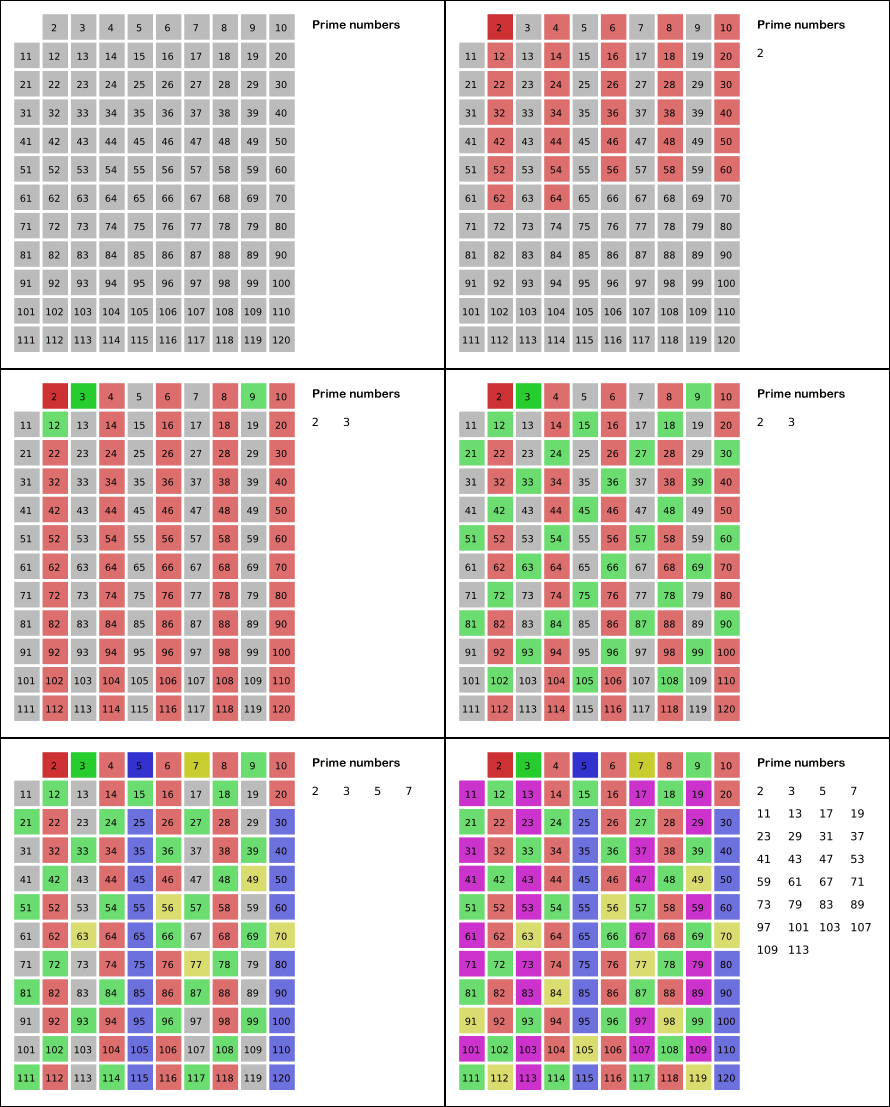


I guess it makes sense as an exercise for beginner coders because it's a pretty easy to understand algorithm, a set of steps for a brain or computer to work through to get a set of outputs (here, prime numbers).


So - as previously advertized - below is one way of getting the R programme to become, for a thrilling and infinitely repeatable moment, the head librarian of Alexandria. After the code itself I'll break it all up into bits, accompanying each bit with some comments that hopefully a) are correct and b) help you understand what's going on. Code is bold, the commentary (a highly Alexandrian form) not. The commentary is talking to R and telling it what to do (imperative mood).


sieve <- function(n) {   
if (n < 2) return(NULL) 
  a <- rep(T, n) 
  a[1] <- F 
  for(i in seq(n)) { 
    if (a[i]) { 
      j <- i * i 
      if (j > n) return(which(a)) 
      a[seq(j, n, by=i)] <- F 

   }
  }
}

sieve <- function(n) { 
Make "sieve" a function that does the below to a number we'll call "n." (This just names our algorithm and makes it a function, a way of doing things to what's in the brackets that follow).

if (n < 2) return(NULL) 
a <- rep(T, n) 

If n is smaller than 2 then spit out NULL. (In other words, refuse to do this computation if it's on a number of numbers less than 2).

Make a vector called "a" and store in it n repetitions, all marked "true." (T stands for 'true.' This is like writing out the number in the grid above. Saying they're all true effectively means we're starting with the assumption that they're all prime.)

a[1] <- F 
Store the first item as false in "a." (Because we want to get rid of 1 immediately?)

for(i in seq(n)) { 
Start with i = 1, iterating the code between here and the closing }, incrementing i by one each time, until i = seq(n). (Note the opening curly bracket. The code within the for loop, contained between the curly brackets, will run a number of times equal to the number of elements in seq(n), starting with i = 1, and with the value of i increasing by one each time it runs.)

if (a[i]) { 
If a[i] is true, the code within the ensuing curly brackets will execute. If a[i] is false, it won't. (So if an individual number is false, it won't run the code. At this point that's just 1, as specified above, so I think this just stops R running this algorithm with the number 1. That's actually important, because if it did it would cross off all the numbers and we wouldn't get any primes; another way of looking at this is that being a multiple of 1 doesn't mean a number isn't a prime, and the algorithm needs to recognize this.)

j <- i * I
This finds the square of i and stores it in variable j. Remember we're in the for loop, with i incrementing each time the loop repeats. The first time round i = 1 and j = 1; the second, i = 2 and j = 4; the third, i = 3 and j = 9; and so on.

 if (j > n) 
If (and only if) the square of i is greater than the number of elements in the entire sequence...(i.e. that number times itself is larger than e.g. 100...)

return(which(a)) 
Return the sequential positions of all those numbers in a which are true (T). (The idea here is that if we've reach a number whose square is greater then the number of numbers in the sequence, e.g. 100, then we've found all the primes already. I guess this is just a separate assumption that happens to be true?)

a[seq(j, n, by=i)] <- F 
Mark as F (false, i.e. not prime - in other words, cross out) all the numbers in a between the jth and nth (the nth being the last) that are divisible by (that's what 'by' does) i (and thus aren't prime). This line is the heart and soul of the code, the steely essence of Beta's colander. 

OK, I'm still not sure I understand all of that, so if you want to try to help out in the comments be my guest. 

Saturday, 6 June 2020

Stairway walks in Wellington #1: Oriental Parade to Mount Vic Lookout (and back again)


This post is a tribute to Ada Bakalinsky and her classic Stairway Walks in San Francisco, which was once gifted to me by a fellow Hellenist. Anyone who's lived in both cities (as I've had the good fortune to do) or has even been to both immediately notices the similarity - both are compact, hilly cities build around a bay (with all the weather that that brings). And, though SF's obviously a lot larger, I'd wager that windy Welly can more than hold its own in terms of unexpected shortcuts from one vertical plane to another, and in terms of stairways in particular. So I thought I'd write up a Bakalinskian 'stairway walk' in Wellington here, partly just because it's an enjoyable thing to do. It may be the first of many, or the last of one. We'll see.

But for now, here's a walk that'll take you from down by the harbour on Oriental Bay up to the commanding heights of Mount Victoria Lookout and back again, with an embarrassment of prospects along the way. It think it took me about an hour and a half, but I could imagine it filling out up to two hours if you lingered a bit longer at the top to luxuriate in the panoramic views. (The Google Maps estimate doesn't seem to account for the incline, and it's pretty much all inclines).

The Freyberg Pool is a good place to start - it's within striking distance from Courtenay Place, the city's entertainment hub, and is easy to find (it's a massive sports complex jutting out into the habour). Walk back down the road toward the city with the harbour on your right until you get to the cafe Lola Stays. Just to the left of that is a long steep row of steps. Go up those and turn right up another little stairway. Go down the road with the Copthorne Hotel on your right, then turn left then left again onto McFarlane (trust me, it's the only way). Keep going up McFarlane as it dips down and then soars up until the boats below start looking like toys.


On your right you'll start to see a old (well, early 20th century) brick monastery looming above you - that's St. Gerard's. There's a stairway just to the right of it. Go up that with the monastery now looming above you to the left.


Then just continue upwards along the road till you come to the start of the town belt on Mount Victoria. Once you've entered into the forrested realm (where the Dark Riders once roamed), things can get a bit confusing. There are so many little paths! Try to stick to the main one, and if you stray off it (as you probably will), just keep going up and to the right, way from the water sparkling away to your left through the trees.


Near the top at least you should be able to re-join the main walk-way, and start getting a sense of how things are about to open up into light and sky.


At this point you'll see Mt. Vic lookout itself, with its monuments, artifacts, and 360 views of Wellington Harbour (as well as its glimpse of the Cook Straight).


And somewhere down there you'll see St. Gerrard's again, this time with you looming above it.


At this point (if you want to follow this walk) look out for the Lookout Road (with the radio tower on the right of it), and walk along that, looking out along the way for look-outs, e.g. one onto the Westpac Stadium (a.k.a. 'The Cake Tin').


At the end of this there's a little lookout nook with a statue of the city's eponymos. And more views (e.g., if you look the other way from the last picture, it's like you're not really in a city at all).


From here there's another little stairway to the right. If you go down this you'll walk through or past a little green area/lawn/park. Here's the view back up the hill once you've done that.

As the sign suggests, you're now on Thane Road. Follow this on its winding downhill trip (with more views on the right over Evans Bay) until you turn a sharpish right corner with another green area to your right. (And a sign for the Southern Walkway). Get on this. It's not a stairway but it probably should be. Instead it's a virtually vertical concrete path that'll takes you like a glass elevator down as you face the harbour.


There are a couple of turns off here. You can basically turn left and even more sharply downhill whenever you feel like getting back to Oriental Parade. I think this one turns off onto Hay Street, but I kept going onto Glass. Here's the NuZild-shabby little park marking the turnoff onto Glass.


Just down the road from here there's also a secret meditation spot where, the day I was there, someone had left their passport - and then returned to get it just as I was wondering what to do. Anyway, once you've had your moment of reflection in the face of the harbour you can turn down to your final staircase, at which point Oriental Bay will be there to welcome you back.


And then? Get an ice-cream, lay on the beach, go for a swim - whatever you want. As with Bakalinsky's bountiful book, there are plenty of possible add-ons and variations, as well as completely different routes in the same area. This was just to get you started in case you needed an idea. Oh, and here's that last area on a slightly better map. If you want you can not turn down Glass but instead keep going to the end of the Southern Walkway, which would probably add 15 minutes or so.


Friday, 29 May 2020

Is Theodor Fontane the German Hardy?


Again, I don't know enough to say. I did just read Unterm Birnbaum (Under the Pear Tree) and there were things about it that reminded me of Hardy - the strong sense of place, the use of local dialect, the pastoral setting combined with some very dark themes. The prose is deceptively simple, also, I think, like Hardy's. There's also the fact that Hardy and Fontane both seem to be in that rarefied set of writers who've achieved greatness both as poets and novelists. And that both touched on topics that were seen as 'inappropriate' by the society of the time.

Fontane seems most well-known in the German-speaking world for his ballad 'John Maynard' about a steamship captain on Lake Erie whose ship caught fire but who stayed with it and steered it to shore. Bizarrely to my mind, the repeated, 'Und noch ---- Minuten bis Buffalo!' ('And ----- minutes more to Buffalo!) has apparently been etched into the memory of generations of German school children. It is an exciting poem. The rest of Fontane's ballads read as very alien nowadays, even (or maybe especially) the 'English-Scottish' ones.

Fontane's lyric poetry, though, is straightforward, lucid, and, I would say, moving. (In the first two of these qualities his lyric poems are different to Hardy's.) I just wanted to post a couple here. The beauty is all in the simplicity - a simplicity which is, again, often a slightly deceptive one.

Der erste Schnee.

Die Sonne schien, doch Winters Näh’
     Verrieth ein Flockenpaar;
Es gleicht das erste Flöckchen Schnee
     Dem ersten weißen Haar.

5
Noch wird – wie wohl von lieber Hand
     Der erste Schnee dem Haupt –
So auch der erste Schnee dem Land
     Vom Sonnenstrahl geraubt.

[6]
Doch habet Acht! mit einem Mal
10
     Ist Haupt und Erde weiß,
Und Freundeshand und Sonnenstrahl
     Sich nicht zu helfen weiß.

I don't have any great grasp of German poetry, but the simplicity, the 'naive' joy in nature, and the bittersweetness of the ending - the sense that certain kinds of longing are inevitable - reminds me of nothing so much of Wilhelm Müller's Winterreise, as famously set to music by Schubert. All these notes - simplicity, an intimacy with nature, and, finally, of the inevitability of life's joys passing - all that is even stronger here:

In der Krankheit.
(Brief an E.)

     Mein ganzes Zimmer riecht nach Wald,
Das machen die kiehnenen Tische,
Glaub mir, ich muß genesen bald
In dieser Harzesfrische.

5
     Du bist noch kaum bei uns daheim
An unsres Kindes Bettchen,
Und sieh, schon sitzt ein muntrer Reim
Auf meinem Fensterbrettchen.

     Er sitzt allda und schaut mich an
10
Wie auf dem Felde die Lerchen
Und singt: „Du hast ganz wohlgethan,
Dich still hier einzupferchen.

[21]
     „Steh nur früh auf und schweif umher
Und lache wie der Morgen,
15
So wird dies grüne Waldesmeer
Schon weiter für Dich sorgen.

     „Und schied’st Du doch zu dieser Frist,
So tu es ohne Trauern,
Das Leben, weil so schön es ist,
20
Kann es nicht ewig dauern.“


Friday, 22 May 2020

Why is chess stressful (but the Eucharist is not)?


Despite its image as a sleepy past-time, chess can be stressful. Players' heart-rates rise and fall dramatically during games. Top grandmasters can expend thousands of calories during tournaments, shedding alarming amounts of weight as a result. Players have even died of heart failure in the middle of competitive matches, crushed by the pressure they were putting on their system.

What makes this sedentary pursuit so stressful? Two things. One is the presence uncertainty and of threats - to your position, to your King, and ultimately to your pride - something which is bound to activate our hard-wired 'fight or flight' response and everything it brings in its train (like an increased heart-rate). The other is the need to make decisions.

Decision-making is, of course, the stuff of life. And it's exhausting - in a way that has now been tracked, measured, and given a label: 'decision fatigue.' The more decisions you make, the more tired the 'executive' parts of your brain get, and the worse you get at decision-making. It's why even top top chess players can make embarrassing blunders near the end of grueling matches. It's also why busy executives have taken steps to reduce the number of decisions they make in a day. President Obama had a chef decide his food for him. Steve Jobs always wore the same clothes.

If we find uncertainty and threats - and the related need to decide how to react to them - unpleasant, it should be no surprise that we also find environments in which we don't have to deal with these things more amenable. This is what a lot of rituals and religious practices do: they set up a programme of repetitive movements or phrases, repeated over time, which are almost completely predictable. That predictability removes any uncertainty. It removes any threats. And it removes the need for us to make, or take, any decisions.

The problem is, we actually like making decisions. More precisely, though we don't always enjoy the actual experience of having to make our minds up, especially when there's a lot at stake, we like being able to make decisions for ourselves, especially when there's a lot at stake. That's basically what autonomy or freedom is, something people often want to defend, even to the point of extreme hardship or death.

This, then, is what makes chess stressful and the Eucharist not. One presents us with threats (even if of a purely intellectual kind) and forces to make a series of difficult decisions quickly. The other temporarily suspends our decision-making, banishes all threats, does away with uncertainty. The philosopher Schopenhauer thought that this is also why we enjoy music. Listening to a sequence of notes, in fact, involves even less activity on our part. It is, in a sense, pure ritual.

But it also involves a suspension of our agency. And agency or autonomy, as we've seen, is also something we want. It's crucial, then, to find a balance between activities that allow us to rest by putting our agency in cold-storage, and those that force us to do things in the world - stressful as that is. And it might be crucial not just for individuals, but also for societies.

That's not just because both things are good, but because in this as in other contexts, rest, besides being pleasant in itself, improves and freshens action, and action, in the final analysis, is what life is made of. Occasionally surrendering our freedom - if only in specific, tightly-constrained ways - might allow us to defend and exercise it all the more energetically.


Saturday, 16 May 2020

Wealth and health


One of the tropes of the current crisis has been that to re-open the economy is to sacrifice lives on the altar of profits. It's also been widely pointed out that this is a false dichotomy. In fact, wealth and health tend go together. Economic downturns lead to deaths as predictably as viruses. In this post I just want to re-state this view one more time, since I think it's a crucial one to grasp if we want to react sensibly to this (or any other crisis).

As the above graph suggests, there's a positive association between longevity and GDP. GDP and child mortality seem to be inversely related. Deaths from the five most lethal infectious diseases have declined as the global economy has grown.

Correlations like this aren't a slam-dunk case that wealth causes health. Studies that have looked at the association in detail have found it to be a slightly complicated one. But even if the exact causal mechanisms at various stages of growth can be difficult to disentangle, the basic picture seems clear: wealth and health tend to go hand in hand. That's the case not only if you look at individual countries through time, but also if you look the set of countries at a particular point in time and compare the well-being of people in richer and poorer parts of the world (even controlling for other factors).

Moreover, unlike in the case of spurious associations (scores for M. Night Shyamalan's films going down on Rotten Tomatoes in line with newspaper sales, for example), it's not hard to think of reasons why these two variables might be linked, and why the wealth of a country might help its people be healthier. Richer countries can give more funding to health services. They can invest in better-quality housing, safer infrastructure, and a more comprehensive social safety net. Its citizens are wealthier, and they can spend more money on their well-being.

So far we've been looking at the positive side of the story, with better wealth being associated with health. But there's also a dark side to the association, with poverty being associated with disease and shorter life-spans.  You can see this effect with economic downturns even in the rich world: opioid deaths rose by 85% in parts of the US where car factories had closed down (and here too it's easy to think of how this might have happened, with unemployment leading to despair and addiction). A 1% rise in the unemployment rate makes working-age men 6% more likely to die of any cause.

And that's in the rich world. Economic growth is even more vital to the developing world, since increases in wealth just make the citizens of rich countries even healthier, whereas people in poor countries live much closer to death and disaster. They're highly dependant on trade and exchange with the rich world. It's no surprise that UNICEF is now predicting a 45% rise in child mortality because of lockdown-related disruptions.

The relationship between economic downturns and health does have its complications. Some studies suggest fewer people die in the actual course of recessions than normal (although more people die of particular causes, like suicide), but there are lasting health costs over the longer term. So even if the coronavirus lockdowns are followed by a V-shaped recovery, with locked-up demand immediately bursting out again, then we might expect our health (on average) to be slightly worse than it otherwise would have been over the next few decades.

There probably are a few people out there who would put profit for themselves ahead of other people's lives. But most of the people raising warnings about the lockdowns are probably just trying to draw attention to the harm we can do to ourselves if do too much damage to the economy. Whether Covid-19 is dangerous enough to justify the public-health costs associated with the economic downturns that are now starting to bite - that's a different question, and one that's best left for another day (and maybe even another website). But it's not a simple question.

'Your money or your life?' isn't a question that, in ordinary circumstances, anyone would want to be asked. But it's actually a much easier question to answer than the one many countries are faced with now.


Saturday, 9 May 2020

Parkour for the course


A few years ago, an old friend from my rugby-playing days started telling me about his new workout ideas. Henry kept on playing rugby union long after I stopped, and had gotten to semi-professional level in England. Whatever sport he was doing he always worked out a lot in the gym, and had started doing so back when it wasn't yet seen as an automatic thing for rugby players to be doing. Now Henry had left the gym behind for a looser routine of kallisthenics in the park on the way home from work. He'd started making fitness videos based around some of the new moves he'd been practicing. And he talked about how his wife, a yoga and pilates instructor, had helped him think more about 'mindful movement.'

Now, if all of this sounds like a bunch of hippy horseshit to you, let me me just up the ante before I explain why I think there might be something to it. Another person I remember using some of the same language was a yoga instructor on one of the unreasonably pricey and slightly cultish places on Valencia in San Francisco. He talked about how he used to do a lot of cycling, and how that had taken a toll on his body, so he gave it up for yoga. I thought at the time that it made very little sense: there was so much good evidence for the benefits of aerobic and resistance exercise (both of which are offered by cycling), and, actually, relatively little for the benefits of yoga.

With a crick in the my neck from doing more cycling than usual because of the lock-down, I've started to reconsider. That's partly because of the former massage therapist Paul Ingraham's admirably skeptical and empirically-focussed blog Pain Science, which is slowly bringing me round to a slightly new way of thinking about muscular health and sickness. (Ingraham sees a lot of chronic muscular pain syndromes of the sort I've long had in my neck and shoulders as caused by 'sick muscles' - muscles in dysfunction either because of over-use or under-use).

It's not entirely clear what's going on when people get the kind of muscle knots that are associated with long-lasting muscular aches and pains. What does seem relatively clear (as far as I can tell) is that overuse of particular muscles correlates with more of these 'knots.' At the same time, as Ingraham points out, under-use of the muscles can have equally unpleasant effects. One point he makes is about static-ness, at work or at home - that is, keeping the same position for hours on end. He's skeptical about workplace ergonomics programmes which, for him, encourage people to try to find the 'perfect' posture, where what causes discomfort and pain isn't really what static position you're in, but the fact that you're in any static position for big chunks of each day. The solution is to engage in a regular series of 'mobilizations,' moving and stretching your limbs and joints through at least forty or so repetitions.


The point Ingraham makes about immobile postures made me wonder about mobile ones as well. Is spending a couple hours in the same position on a bike any better? Sure, you're moving, and you will get all the benefits of the exercise involved in spinning your legs (which are considerable). At the same time, the rest of your body is basically immobile. Running is a bit better, but your body is still going through a reasonably restricted range of movements. Using the weight machines in the gym will get you moving through a variety of shapes, but only a set number. Even yoga classes can focus on only a few classics poses, powerful though these classic poses can be. Squash is probably the most dynamic thing I do, but that, too, ultimately involves a set palette of movements, and it's quite one-sided (something I very much feel down one side of my body after a long match).

Ingraham's 'mobilizations' are apparently just his version of a new line of 'mobility drills' that physios are getting into at the moment. One of the key things about them, though, is their looseness and freedom. He suggests that they're 'exploratory.' And that's where the mindfulness comes in - not, in this case at least, as hippy horseshit, but as a kind of fine-grained empiricism. The idea is just to be aware of where the muscular pain and discomfort is and to move and stretch there, in whatever way you feel like moving and stretching. (Assuming, of course, that it's the chronic, tiring-feeling kind of muscular pain we're talking about, not something like a tear.) No need to do things that have a name or a history - you can do whatever the hell you want, as long as it involves moving and stretching, and you'll be doing a mobilization.

All of this explains why I've become a late convert to parkour. The lockdown has meant the gym and the pool -  two of my weekly standbys - are no longer a noption, and neither are yoga classes. (For some reason it's always harder for me to have a good yoga session at home - I need a third-party enforcer to take up a series of awkward postures and take five sounding breaths in them.) That's led me to wander around town doing pull-ups in scaffolding, climbing trees, jumping off concrete ramps, throwing large rocks a short distance into the harbour, jumping up and down onto plinths, swinging on lamp-posts, doing one-arm push-ups on bollards, doing two-arm pushups on bits of grass (34 is my current record), doing leg lifts on bits of grass (34 is my current record), going up and down any ladders that cross my path (3 or 4 is my current record), and occasionally even engaging in 'jumping-jacks'  (7).

You can see a picture of me engaging in hyper-legit urban-jungle street-running above. I'm too old and wise to go in for any of the actually risky parkour that the cool kids do (why bother?), but I can see why they like running around and swinging onto things and jumping off them. They're going through their exploratory mobility drills in just the right spirit, of creative freedom and fine-grained empiricism.

Speaking of empiricism, my theory of why unstructured exercise might be better for keeping aches and pains at bay may of course turn out be complete bollocks. I don't know of any studies that compare more unstructured forms of exercise with more regimented types. If you do, feel free to put them in the comments. Paul Ingraham often talks how most doctors and research scientists are too busy thinking about the really harmful stuff (major diseases) to have much time to spend on aches and pains. But chronic pain can be a major downer, and it's surprising from the economic standpoint if no other how little research seems to have been done even on such widely-used concepts as muscle-knots. After all, people spend a lot of money on massage and various sorts of complimentary therapy, even if even the less wacky-sounding ideas they depend on (smoothing out muscle tissue, say) don't have all that much research behind them. So surely it's time for us to start running some tests on the free-runners.


Friday, 1 May 2020

The Rediscovery of Johnny Baloney

Another thing it turns out I'm ignorant about (although I might have suspected it) is the short-lived but spectacular flowering of cast-bronze sculpture in southern Germany around 1600. This took place mainly in Munich, seat of the Wittelsbach princes, and Augsburg, home of the HNW Fuggers - no coincidence, since casting large-scale sculptures is bronze is enormously expensive. The 'Neptune ...taming a sea-horse...which Claus of Innsbruck cast in bronze for me' that the speaker of Robert Browning's 'My Last Duchess' draws his guest's attention towards is supposed to speak loudly about his spending-power. It's also a quiet reminder of a river of artistic influence on which bronze deities of all sorts flowed between northern Italians states and southern German ones as the 16th century drew to a close. 

At the head of this river was a Dutchman, usually known by the less than compellingly Dutch name Giambologna (French Jean de Boulogne). A portrait of him by Hendrick Goltzius (more convincing Dutch name) is above, partly so that he'll stand at the head of a river of images in this post. And partly as a thanks for leading, directly or indirectly, to the flood of monumental bronzes that visitors to Munich can now wade into. 

There's at least one weighty tome on this topic by others who know vastly more about it than I do. So instead of trying to write anything much about it, here's a quick intro in images.

Let's start with two works by Giambologna himself, both on classical themes: the Rape of the Sabines (1574-82) and Hercules and Nessus (1599), both now in the Loggia dei Lanzi in Florence.


Literal tonnes of smaller bronze versions of these are around (including in a room in the Bayerisches Staatsmuseum  in which my personal rediscovery of Johnny Baloney was made). Some are better than others; here are two chosen at random:
One bronze in Munich that is by Giambologna himself is the towering crucifix in Michaelskirche, a gift to the Wittelsbachs by their fellow jet-setters the Medici. There was a connection there, with Albrecht V of Bavaria's sister-in-law marrying Francesco de Medici in 1565. And, of course, their wedding forged a link in the bronze-casting chain, with Hubert Gerhard, a student of Giambologna,  going on to work for both the Fuggers in Augsburg and the Wittelsbachs in Munich. Here are two examples of his efforts, the archangel Michael defeating Lucifer on the facade of the Michaelskirche, and Perseus holding up the head of Medusa (this one in the Wittelsbachs' Residenz palace in Munich):


Soon the Wittelsbachs decided to breed their own sculptors by sending talented sons of Bayern to Florence. Two of the most successful of the new crop were Hanses Reichle and Krumper. Here's another Michael by the one Hans, above the entrance to the Zeughaus in Augsburg; and the tomb monument of the Holy Roman Emperor Louis IV (a Wittelsbach) by the other Hans, in the Munich Frauenkirche:


I've saved probably the most recognizable of Giambologna's works for last, the Flying Mercury from around 1580. This one has been extensively copied and played off, and has turned up all over Europe - including, of course, in the Wittlesbach's home in Munich. What better image of the swiftness and borderlessness of artistic influence could there be?