Showing posts with label Greeks. Show all posts

Saturday, 26 September 2020

Be with us now


In the depths of the lockdown, in the middle of my fortnight's stay at a quarantine hotel, I saw my friend. He was standing there at the end of my bed. He was smiling, and exuding the same bonhomie as ever. But the feeling I had upon seeing him wasn't joy. Why not? Because he had died a few months earlier. 

If I was living in a less rationalistic culture - any other culture than the one I do live in - I have no doubt I would be talking about that episode as the visitation of a ghost, spirit, or angel. As it is, I'm more inclined to believe it was a dream. Though maybe a dream of a particular sort, born of particular circumstances. 

I'm talking about lockdown dreams, the particularly vivid dreams that people have been reporting after weeks of being cooped up at home or in a hotel, sometimes without seeing another living person for weeks on end. These dreams come in different shapes and sizes, and not all of them involve people, but the ones that do suggest an obvious explanation. Are these dreams the result of our brains' effort to make up for the lack of human contact by providing us with the images of our friends?

It's interesting to me that, in the same period that I had the dream I mentioned, I was also praying to Mary with the rosary, something I'd never done before in my life (I've never been a Catholic, and I'm not one now). There were other reasons for that (I'd just been in a city with some beautiful Catholic churches, where I'd been exposed to and drawn to the practice), but it has struck me that it is a style of meditation that involves, first and foremost, calling upon a figure, a personality, a person.

Prayer, of course, often works in this way. Christians call upon God, Jesus, Mary, and various other saints. Muslims call upon Allah. Buddhists call upon Buddha and numerous bodhisattvas and spirits (and sometimes even visualise them as a form of meditation). Ancient Greeks who were ailing would call upon the healing God Asclepius and then go to sleep in one of his sanctuaries, where he would then appear to them in dreams. 

There are many reasons why people pray, but one may just be loneliness. We want another presence in the room, in our lives, for the night. In a sense, religious activity is a way of inviting people over, for dinner, say, and is often figured as such - the Greeks imagined the gods enjoying the smoke from their sacrificial feasts, and the Christian Eucharist re-enacts the Last Supper, seeing Christ as really (or symbolically) present once again. 

The many different forms of religious ritual obviously imagine different sorts of togetherness with different supernatural guests. And, as with ordinary guests, we may want to invite them over for different reasons. We may want to invite over someone powerful and reassuring, someone who will allow us to sleep with some sense of safety. We may want a mother-figure to smile down on us and tell us everything will be alright. We may want a raucous fellow-reveller like Dionysos.

None of this is to suggest that sending out invitations of this sort is necessarily a silly thing to do, even if we don't happen to believe that any of the guests are really going to be there. Whether or not we find it silly may, in any case, in some sense be neither here nor there. It may simply be something we humans do during lockdowns, in the desert, in the hour of our death. We find other ways of having our friends over, other ways of seeing them. 


Saturday, 11 July 2020

Bow, wow


My first Greek teacher at school was one of those wizened, old-school schoolmasters they don't seem to make anymore. He was a deeply civilized man - he played the cello and the piano to concert standard as well as being able to talk more entertainingly about Cicero (an advanced skill in itself). He was usually kindly and often humorous, but he also had a stern side. I remember him leaning over my friend (who had just farted in class), his face inches away, pronouncing, very distinctly, 'Let nothing get in the way of learning!' It was rumoured he'd been in the SAS. When we got too rowdy supporting the First XV he would simply walk along the touchline and we'd all go quiet.

It was the same walk as he had in chapel. Somehow he was always the last one in, though I don't think that was an official role. We'd all be fidgeting, gossiping, poking each other with compasses, that sort of thing. He would walk down the aisle, his clipping shoes sealing up the silence behind him like he was zipping up the door of a tent. And when he got to the end, he would bow his head to the altar.

It was interesting to me partly because he was usually so upright. Later I encountered the same oscillation between bowing and upright posture at the San Francisco Zen Centre. It took me years of experience with different Buddhist groups before I could put aside my distaste for bowing to Buddha statues. Whether it was a Western egalitarianism or a Protestant distaste for idols, I didn't like it. Part of me still doesn't. And - something it's taken me years to admit to myself - part of me does.

The rationale for the formal postures they have at Western Zen centres tends to focus on mindfulness. Bowing and then standing upright and so on at different times certainly does require a certain alertness, but there's also something else going on. Shunryu Suzuki, the founder of the SF centre, apparently tripled the number of bows there because he thought Westerners needed to 'get their heads down.' The Tibetans who do full protestations have a phrase about that practice as a way to 'turn the cup upside down.' Bowing is, in other words, a way of practising and cultivating humility.

But it can also go deeper. Pack animals that have clear hierarchies in the wild - dogs, for example - seem to feel more secure in the presence of a undisputed top dog (a role human owners have stepped into). We may have something of this in ourselves. Bowing to Christ or the Buddha may be as much about handing over responsibility to them as anything else. And surrendering responsibility over ourselves is something we seem to find strangely comforting. There's something of this in the erotic sphere too, with a whole subculture of people who enjoy putting themselves in subordinate positions. Kneeling as part of oral sex and as part of religious ritual may not be as far apart as we like to think (a similarity that's been noted by generations of poets).

An increase in humility in one person is often accompanied by a growth in pride somewhere else, though, and humility can sit dangerously close to humiliation. That's what used to give me the willies about bowing, and still does occasionally. The Kings of Persia used to demand a full prostration from their vassals, something the Greeks called proskynesis. (Earlier, Kings of Assyria had required the same form of obeisance; below is the black obelisk of Shalmeneser III, who is standing over the defeated Jehu of Israel). When Alexander the Great started demanding similar treatment, his Greek and Macedonian peers took it as a sign of a slide towards tyranny. Forcing people into head-down positions and onto the ground can be elements of torture, featured from medieval heresy trials to the prisons at Abu Ghraib.


The former San Francisco 49ers quarterback Colin Kaepernick's ritual of 'taking a knee' in protest against perceived injustice has now been more widely adopted as part of the 'Black Lives Matter' movement. The posture is uncannily similar to the way Catholics genuflect to the altar. That, of course, isn't necessarily to the discredit either of the protests or of Catholicism. As we've seen, bowing clearly has deep roots in human psychology as an expression of devotion. It's a central part of the human palette of gestures, as much as hugging someone or jumping for joy.

As the same time, given its potential for abuse it's easy to see why some (like the UK Foreign Secretary Dominic Raab) have refused to take a knee, seeing it as a symbol of submission. That it clearly is, though perhaps what's really going on in such cases isn't a distaste for submission in any context, but simply for submission to that particular cause (and Raab did indicate that he would bend the knee for the Queen). My old Greek master bowed to his idea of God, but apparently not for much else. This might be part of the point of religious types of bowing, to find a way of satisfying the human urge for submission in a way that nonetheless preserves our independence. Whether that works out in practice will depend partly on your idea of God.

Others will particularize their acts of submission, holding their heads up high in everyday life while choosing not to in certain contexts. But it might make sense to always remain a little on guard wherever we choose to bow our heads. I know it's possible to get too hung up on this; after all, bowing is a very common way simply of greeting other people across the Far East. But when it comes to more ritualized bowing, the kind of bowing that turns your heart upside down, it might be worth choosing your masters wisely. Be careful, in other words, what you bow to.


Friday, 19 June 2020

Beta's colander


Buy SWHF Stainless Steel 5 L Jumbo Colander and Strainer Online at ...
This is a classic titanic post, because (as so often) I don't really know what I'm talking about. Through the lockdown I made a half-hearted attempt to learn R, the leading statistical programme. As usual, what caught my eye was an ancient Greek. 

Specifically, Eratosthenes of Cyrene. Eratosthenes is one of the great figures of Hellenistic Alexandria. He was head of the library there, the highest intellectual position of the day. He's best remembered today for estimating the circumference of the earth to an astounding degree of accuracy, but he was also a polymath interested in literature, music, and, as we'll see, mathematics. He was called 'Beta' by his peers, not because he was on Reddit, but because he was the second best at everything.

Not too far into my studies in R, I came across Eratosthenes' sieve, a simple algorithm that's often used as an exercise for coding students. What follows is an attempt to unpack one way of coding Eratosthenes' sieve in R, with some help from a friend and some code I found online. I struggled with it a bit myself, which should hopefully put me in the ideal position to explain, since I can remember what confused me (everything), and nothing about it seems obvious to me. 

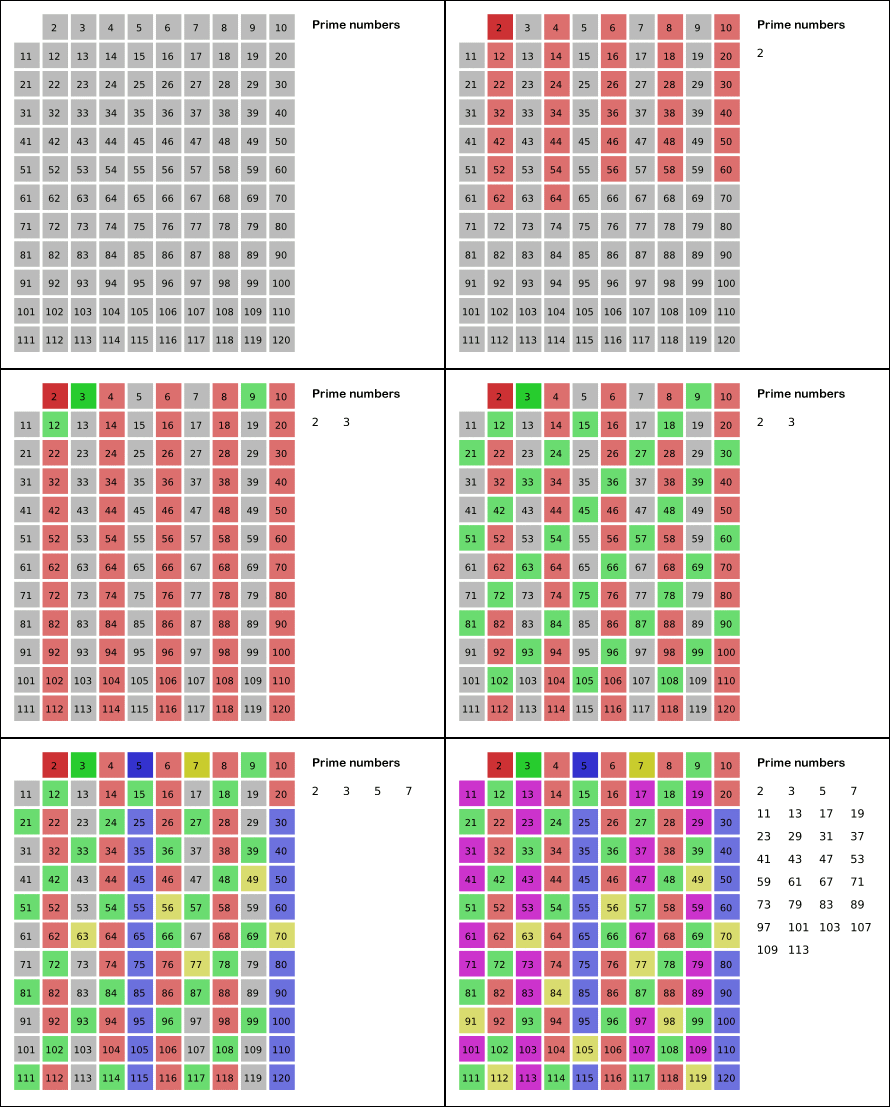
I'll start with the sieve itself. The point of it is to find all the prime numbers up to a certain point (let's say, up to 100). Starting with 2, what you do is to move through the rest of the numbers crossing out all of the multiples of 2 (since if they're multiples of any other number higher than 1 they can't be prime). Then you do the same with 3, 4, and so on, until you can't do it anymore, since all the multiples of the number you started with have already been crossed out (as multiples of an earlier number). Then you can look at all the numbers that haven't been crossed out. Those are your primes. 


I guess it makes sense as an exercise for beginner coders because it's a pretty easy to understand algorithm, a set of steps for a brain or computer to work through to get a set of outputs (here, prime numbers).


So - as previously advertized - below is one way of getting the R programme to become, for a thrilling and infinitely repeatable moment, the head librarian of Alexandria. After the code itself I'll break it all up into bits, accompanying each bit with some comments that hopefully a) are correct and b) help you understand what's going on. Code is bold, the commentary (a highly Alexandrian form) not. The commentary is talking to R and telling it what to do (imperative mood).


sieve <- function(n) {   
if (n < 2) return(NULL) 
  a <- rep(T, n) 
  a[1] <- F 
  for(i in seq(n)) { 
    if (a[i]) { 
      j <- i * i 
      if (j > n) return(which(a)) 
      a[seq(j, n, by=i)] <- F 

   }
  }
}

sieve <- function(n) { 
Make "sieve" a function that does the below to a number we'll call "n." (This just names our algorithm and makes it a function, a way of doing things to what's in the brackets that follow).

if (n < 2) return(NULL) 
a <- rep(T, n) 

If n is smaller than 2 then spit out NULL. (In other words, refuse to do this computation if it's on a number of numbers less than 2).

Make a vector called "a" and store in it n repetitions, all marked "true." (T stands for 'true.' This is like writing out the number in the grid above. Saying they're all true effectively means we're starting with the assumption that they're all prime.)

a[1] <- F 
Store the first item as false in "a." (Because we want to get rid of 1 immediately?)

for(i in seq(n)) { 
Start with i = 1, iterating the code between here and the closing }, incrementing by one each time, until i = seq(n). (Note the opening curly bracket. The code within the for loop, contained between the curly brackets, will run a number of times equal to the number of elements in seq(n), starting with i = 1, and with the value of i increasing by one each time it runs.)

if (a[i]) { 
If a[i] is true, the code within the ensuing curly brackets will execute. If a[i] is false, it won't. (So if an individual number is false, it won't run the code. At this point that's just 1, as specified above, so I think this just stops R running this algorithm with the number 1. That's actually important, because if it did it would cross off all the numbers and we wouldn't get any primes; another way of looking at this is that being a multiple of 1 doesn't mean a number isn't a prime, and the algorithm needs to recognize this.)

j <- i * I
This finds the square of i and stores it in variable j. Remember we're in the for loop, with incrementing each time the loop repeats. The first time round i = 1 and j = 1; the second, i = 2 and j = 4; the third, i = 3 and j = 9; and so on.

 if (j > n) 
If (and only if) the square of i is greater than the number of elements in the entire sequence...(i.e. that number times itself is larger than e.g. 100...)

return(which(a)) 
Return the sequential positions of all those numbers in a which are true (T). (The idea here is that if we've reach a number whose square is greater then the number of numbers in the sequence, e.g. 100, then we've found all the primes already. I guess this is just a separate assumption that happens to be true?)

a[seq(j, n, by=i)] <- F 
Mark as F (false, i.e. not prime - in other words, cross out) all the numbers in a between the jth and nth (the nth being the last) that are divisible by (that's what 'by' does) i (and thus aren't prime). This line is the heart and soul of the code, the steely essence of Beta's colander. 

OK, I'm still not sure I understand all of that, so if you want to try to help out in the comments be my guest.