Showing posts with label Classics. Show all posts

Sunday, 7 November 2021

When the anti-traditionalists love tradition


One of the several interesting moments in Joanna Hanink's piece 'A New Path for Classics' (which originally appeared under the title 'If Classics Doesn't Change, Let it Burn') comes when the Brown University Classics professor shifts from her critique of the field to 'a new generation of classicists' who, she says,  are turning away from the triumphalist “Western civ” model' and 'becoming better in tune with the world’s shifting realities.' 'The nation of Greece,' she goes on 

has recently been looking to allies beyond Europe. It is forging new economic and cultural links with China in a partnership based, at least rhetorically, on the idea that nations with ancient pedigrees understand each other. The same general premise also underpins the Ancient Civilizations Forum, a cultural initiative with nine member countries in regions that were “cradles of ancient civilizations.” The forum casts the antiquity as a potential source of soft power for modern nations.

There are a few points that might be raised here, from the wisdom of democratic nations cozying up to a communist dictatorship, to 'the idea that nations with ancient pedigrees understand each other.' What I want to highlight in this post, though, is the strangeness of Hanink appealing to 'nations with ancient pedigrees' at all. After all, in the rest of her article she several times casts doubt on 'the claim that ancient Greece and Rome were the “foundation of Western civilization," a 'fairytale Western origin story' that, she declares, she has 'no more patience for.' She also links approvingly to Kwame Anthony Appiah's essay 'There is no Such Thing as Western Civilization.' 

Now, admittedly, it could be the case that the narratives of continuity in Chinese history are correct (though the role of the Chinese state in constructing such narratives should give us pause), and every possible story about Western Civilization is simply false. But there is, I would submit, something quite strange, even less than perfectly consistent, about the position that some narratives of cultural continuity have to be insistently deconstructed while others can be routinely greenlighted. 

Appiah's idea that the Western tradition doesn't really exist is really only one step on from a general scepticism towards tradition that has had a place in the academy for quite some time now. The work that, as far as I can tell, planted the seed for this particular intellectual sub-tradition was Hobsbawm and Ranger's 1983 volume The Invention of Tradition, which discussed examples of traditions being more or less made up out of whole cloth, or at least reified to an extent that the actual historical facts didn't quite support. 

Hobsbawm and Ranger were no fools, and the phenomenon they pointed to was a real one. Traditions, from the Christmas Day address of the British monarch (inaugurated in in 1932) to the Superbowl (1966) are often more recent than we think. There's no doubt that some claims about tradition are more or less (sometimes entirely) mendacious, and that they often serve present-day interests and structures of power. 

But there's a risk of going too far the other way - a risk that, it seems to me, is especially perilous in contexts where the idea we're reacting to is associated with a political Other. Though some traditions - even many - may be invented, or at least patched up, we probably shouldn't conclude from this that all traditions are just made up, and there's no such thing as long-term cultural continuity at all.

One problem with arriving at this kind of conclusion is that talking about traditions and cultural lineages - even ones that reach back into ancient times - can often turn out to be very useful. Unsurprisingly, progressive historians and classicists sometimes find them useful too, as Hanink seems to in her talk of 'nations with ancient pedigrees.' And there are other examples.

Classicists who are in favour of transferring the Elgin Marbles to Greece, for example, usually do so partly on the basis that contemporary Greeks are, in some sense, the heirs (even the compatriots) of Pericles and of the classical city-states. Feminist classicists like Mary Beard are often partial to tracing a 'long tradition' of misogyny back to Greece and Rome. Somewhat further afield, Christianity is seen as having imposed repressive norms to do with gender and sexuality on cultures - in Polynesia, for example - that, it's claimed, had a tradition of more openness and flexibility in these areas of life.

My purpose here, again, isn't to contest any of these claims, or even to discuss them in any depth. At first glance, they all seem to have some plausibility. My purpose here is just to point out that strangeness. If it's true - or even plausible - that there's a tradition of misogyny that can be traced back to ancient Greece, isn't it equally plausible that we can trace a tradition of democracy back to ancient Greece as well? And yet my sense is that the idea of Athens as the cradle of democracy is less popular among American classicists than it used be. 

I noted above that it could be that narratives of Chinese (or Greek) cultural continuity are simply more accurate than notions of 'Western Civilization.' It could be argued, for a start, that 'Western Civilisation' is a more amorphous concept than Chinese Civilization, or Greece. In fact, something along these lines often is argued; although usually this is done by simply stressing the unhandlable multi-facetedness of Western Civilization, not by bolstering a sense of the continuities in national histories. (That, in itself, somewhat gives the game away.)

My own sense is that while we shouldn't uncritically accept stories about tradition (especially ones that stretch over huge spans of time - stories about apostolic succession and dharma transmission both come to mind), we also can't simply assume that all claims about tradition are false. Most of us recognize, I think, that some sort of long-term handing down of ideas and life ways is possible. (Indeed, I would go so far as to describe it as a fairly obvious feature of human society.) 

Whether particular claims about particular traditions are true is something that is best worked out on a case-by-case basis; and I would be the first to admit that there are, for example, simplistic narratives of Western Civilization and the transmission of democracy that don't stack up when set against the messy nuances of historical fact. 

My plea here, I suppose, is simply that we engage each other on a level playing field when it comes to teasing out which aspects of which narratives are sanctioned by the evidence, and which ones aren't. We can't, I think, make sweeping deconstructionist critiques of some narratives ( 'all narratives are constructed,' 'We must take care not to reify notions of "tradition,"' and so on) while exempting others from that style of skepticism. At least, we can't if we don't want those listening into our debates concluding that we're conducting ourselves in a less than perfectly consistent, and even-handed, manner. 


Saturday, 4 September 2021

Classical Americana


Among the many claims about the field of Classics made in the New York Times' lengthy profile of Princeton Classics professor Dan-el Padilla Peralta was that “Classics as we know it today is a creation of the 18th and 19th centuries.” As has already been pointed out, it's a claim that only holds up if we allow the phrase 'Classics as we know it today' to do a lot of work. Classics as a modern academic field within a modern, research-intensive university system may well owe its origins to the emergence of the modern research university in 19th-century Germany. But Europeans have been turning back to classical cultures of the Greeks and the Romans pretty much since Rome fell.

So much is clear from more or less every stage of European history, from the Dark Ages, when monks kept the classical literary tradition alive by copying Greek and Latin manuscripts; through the Renaissance, when humanists like Politian translated and emulated classical writings; to the Enlightenment, when, as Rachel Poser, the author of the New York Times piece, puts it, “a sort of mania” for Greece and Rome took hold of the intellectual classes. The idea Europeans simply invented the classical tradition out of whole cloth in the Renaissance is, in other words, contradicted by virtually the entire history of European culture before then.

It might be objected at this point, as a last-gasp effort to save Poser from what seems like a fairly obvious clanger, that her focus was on the United States, not Europe. 'How these two old civilizations became central to American intellectual life,' she writes (with my added emphasis) 'is a story that begins not in antiquity, and not even in the Renaissance, but in the Enlightenment.' So perhaps her hypothesis isn't that a relationship with Greco-Roman culture became central to European culture only in the 18th and 19th centuries (after all, that's plainly wrong); but simply that Greece and Rome only became big in American culture during the Enlightenment. 

Now, that's obviously true, but it's true for what should have been a fairly obvious reason. Greco-Roman culture only becomes baked into American culture and institutions during the Enlightenment because that's when the United States developed into an independent nation. In other words, there was no United States of America before 1789, and there weren't even any permanent Anglo settlements in North America until 1607. Depending on where precisely you place the Enlightenment, that makes it inevitable that the Greek and Roman classics won't have a big presence in American life before then.

But still, wouldn't the kind of engagement with Greek and Roman history that is on show in the Federalist Papers have been impossible without the Enlightenment? When colonial Americans did wrestle with the Greco-Romans, didn't they always do so in an Enlightenment vein? Well, no. According to Eric Adler, Greek and Latin formed a large part of the curricula of the colonial colleges. And they were taught in a way that reflected two traditions, humanism and scholasticism, that stretch back well before the Enlightenment. 

They were, in fact, taught largely in a Christian vein. This brings us to a fact about Western cultural history that's so obvious that we are, it would seem, no longer capable of seeing it. The Europeans that settled North America in the Early Modern period were, almost to a man, Christians; and Christianity is a religion with roots in the ancient Mediterranean world. When the British settled North America, their religious and educational elites brought the study of Greek and Latin with them in large part because many of their holy texts (the Gospels; influential translations like the Septuagint and Jerome's Vulgate; the works of the Church Fathers) were written in those languages.

We can, as it happens, actually test the thesis that, had Europeans come to the Americas before the Enlightenment, they would have brought an interest in the Greco-Roman classics with them. We can do this because, as you might be aware, Europeans (mainly Spanish and Portuguese) did actually arrive in the Americas well before anyone's starting-point for the Enlightenment. And, sure enough, if we look at Spanish accounts of their encounters with local people, we find references to Greek and Roman historiography. Many of these accounts were, of course, written by priests of the Christian religion, a religion which, it bears repeating, was a central part of the Europeans' cultural inheritance and which has its origins in the Greco-Roman world. 

The real reason that Greece and Rome play such a significant role in the culture of the nascent United States, then, should be fairly obvious. Early Americans (at least the educated ones) talked about Greece and Rome because they came from Europe, and European culture was rooted in the Greco-Roman past. European settlers in the Americas, from Quebec to Buenos Aires, brought European culture with them, and European culture had a significant classical component. The specifically Enlightenment style of classicising engaged in by men like Georgia founder James Oglethorpe, whose utopian schemes were influenced by Plato, was simply the latest wave of classical influence. That it involved engagement with the classics was, in itself, more of a continuation of pre-existing European cultural habits than anything fundamentally novel.

All of this should, to repeat, be fairly obvious to anyone who knows anything about global cultural history. But the power of the ideology that currently has a stranglehold on US colleges is considerable; so considerable, in fact, that it leads college professors to write statements that any layman can see are plainly false. For Rebecca Futo Kennedy, for example, of Denison College, Ohio, modern Americans ‘are no more or no less the heirs of the ancient Greeks than they are the heirs of ancient China.' 

In fact, Americans are clearly more indebted to ancient Greece than they are to ancient China. Their monumental architecture is Hellenizing in style; banks and state capitols look vaguely like the Parthenon, not the Foguang Temple. Modern Americans' political system was created by men who drew on and discussed Polybius and Plutarch, not Confucius and Shang Yang. The higher registers of their main language, English, is full of borrowings from Greek, not Mandarin. And the holiest text of the dominant religion (the New Testament, Christianity) is written in koine Greek, not Old Chinese.  

Once again, virtually everyone who hasn't spent too much time around a modern American Humanities department knows this, and knows why this is the case. Americans are more indebted to ancient Greece than to ancient China because the United States was created largely by Europeans; and European culture, for stunningly obvious reasons, has always been more indebted to ancient Greece than to ancient China. 

But this simple fact destroys one of the central contentions of the extreme 'social justice' approach to Classics profiled in Poser's New York Times piece. This contention, as Poser describes it, is that ideas about the classical tradition 'cannot be separated from the discourses of nationalism, colorism and progress that were taking shape during the modern colonial period, as Europeans came into contact with other peoples and their traditions.' 'Enlightenment thinkers created a hierarchy with Greece and Rome, coded as white, on top, and everything else below,' she goes on. And she quotes Harvard professor Paul Kosmin: 'That exclusion,' he tells her 'was at the heart of Classics as a project.'

This is wrong-headed in any number of ways. For a start, as the cognitive scientist Steven Pinker has had to remind historians, the idea that exclusion, inter-group violence, and slavery was a product of the Enlightenment gets things exactly the wrong way round. One of the things that most clearly distinguishes Enlightenment and post-Enlightenment cultures is precisely their relative inclusivity and pacifism, not to mention their distaste for slavery, an eccentricity that in itself sets them apart from virtually all previous civilisations. 

But the simplest way we can see that the radical revisionist view is wrong is by going back to the obvious facts about Western cultural history that I've referred to in this post. The new would-be orthodoxy is that the classical tradition 'cannot be separated' from ideas that took shape in the modern colonial period. In fact it can, as a simple glance at the classical tradition before the modern colonial period makes clear. 


Friday, 14 August 2020

Harsh but unfair


I remember reading once, in a book on Athenian law (perhaps this one) that anthropologists had observed that in societies where criminals were less likely to be apprehended, penalties were harsher. It made sense; after all, modern developed countries, with their highly developed surveillance technology, have (by historical standards) strikingly lenient punishment regimes; pre-modern ones, by contrast, which had zero or only rudimentary policing, had more of a tendency to turn to the gallows, the guillotine - or the gulp of hemlock.

The observation came back to me recently in connection with the current vogue for 'cancelling.' The frequency of this phenomenon has been questioned, but what seems to concern many people isn't necessarily how widespread it is, but how harsh the punishments can be. A disabled grandfather is sacked for sharing a comedy sketch. A researcher loses his job for re-tweeting a study about the effectiveness of peaceful compared with violent protest. And all the while, not-especially-controversial views and tame jokes elicit the kind of fury that used to be reserved for blood feuds. 

Given the many instances of such 'cancellations' that have occurred, it might seems strange that a good few people continue to insist that the whole phenomenon is made up. But there might be a way of explaining both why they think that and why some of these same people engage in such disproportionately harsh punishings of individuals who violates their norms. 

The reason they think the free speech crisis isn't really a crisis is partly because they see people saying things they dislike all the time. That's been one of the effects of the explosion of social media: whereas twenty years ago you wouldn't often be exposed to views from outside your thought-world, and you'd have to put in some work to have your views broadcast, now it's easy to post things and even easier to see things others have posted. 

If you have narrow parameters for what ideas are acceptable, it follows that you're likely to see quite a lot of what are to you unacceptable ideas. Twitter must be terrifying - all those people saying things you think are terrible! What's more, most of them are getting away scot free.

The temptation, then, is to make an example of anyone you are in a positions to punish, pour décourager les autres. This is what ancient societies were up to as well. It makes sense, especially if you consider the point of view of the potential criminal. 

You can look at risk as the combination of how likely a bad thing is to happen, and how bad it will be if it does. You may not be that likely to fall of the cliff if you go right up to the edge, but if you slip you'll die, so why risk it? If you're in a society without a functioning police force, the chance you'll be apprehended for doing something bad is pretty low. One way for the state to increase the risk you face (and hence deter you from wrongdoing), is to increase the penalty you risk facing. You think you probably won't get caught, but if you do...

The temptation to make an example of someone might be especially great when there are artificial barriers in the way of punishing other people who are up to the activity you dislike. For example, if a lot of the people saying things you find unacceptable are represented by anonymous Twitter accounts. Or if there's been a state amnesty saying you can't punish any of the members of a tyrannical junta.

That last thing, of course, is what happened in Athens after the murderous regime of the so-called Thirty Tyrants. Once the democracy had been restored, there seems to have been an agreement not to prosecute anyone involved with the Thirty, except for the Thirty themselves (some of whom had already been killed in the process of restoring the democracy). (What exactly the amnesty required is, like most things in ancient history, a little bit controversial).

In 399, only four years after the Thirty had been toppled, the philosopher Socrates, who had links to some of the Thirty (including Critias, one of the more extreme members), was executed on a vote of a popular jury. Why? It's complicated; there were lots of factors that led to that outcome, including the way he went about defending himself (if that was even what he was up to) in court. 

But one possibility is that his prosecutors indicted him on a charge of inventing new gods and corrupting the youth precisely because they couldn't prosecute him for what they were really angry at him for - the actions of the Thirty. And they also couldn't prosecute many of the people who they knew had collaborated with the Thirty. Nor could they prosecute Critias and others who were already dead. But Socrates was there, still going about his business asking irritating questions in public...

Note that the theory, if it's right, explains not only the excessiveness of the punishings but also the way they have of mistaking their object. At least, it looks an awful lot like all of the guilt for something is being loaded onto the back of one, unfortunate person who happens to be in the wrong place at the wrong time. That, of course, is another phenomenon that's familiar to anthropologists: scapegoating. 

One way to stop this sort of thing, as you might guess, is to get better at apprehending wrong-doers. But it's very questionable in cases like the ones mentioned above (sharing comedy sketches and so on) whether anyone's done anything wrong at all. Another way is to reduce narrow-minded people's exposure to views they find distasteful. 

Doing that by force would be wrong (people should be free to go on social media, of course), but it might be advisable, considering the kinds of moral risks involved, for some people to think twice about the amount of time they spend online. In other words, if you can't deal with different ideas, it might be best just to stay off Twitter. Otherwise you might find yourself with a cup of hemlock in your hand - handing it to an innocent person. 


Saturday, 11 July 2020

Bow, wow


My first Greek teacher at school was one of those wizened, old-school schoolmasters they don't seem to make anymore. He was a deeply civilized man - he played the cello and the piano to concert standard as well as being able to talk more entertainingly about Cicero (an advanced skill in itself). He was usually kindly and often humorous, but he also had a stern side. I remember him leaning over my friend (who had just farted in class), his face inches away, pronouncing, very distinctly, 'Let nothing get in the way of learning!' It was rumoured he'd been in the SAS. When we got too rowdy supporting the First XV he would simply walk along the touchline and we'd all go quiet.

It was the same walk as he had in chapel. Somehow he was always the last one in, though I don't think that was an official role. We'd all be fidgeting, gossiping, poking each other with compasses, that sort of thing. He would walk down the aisle, his clipping shoes sealing up the silence behind him like he was zipping up the door of a tent. And when he got to the end, he would bow his head to the altar.

It was interesting to me partly because he was usually so upright. Later I encountered the same oscillation between bowing and upright posture at the San Francisco Zen Centre. It took me years of experience with different Buddhist groups before I could put aside my distaste for bowing to Buddha statues. Whether it was a Western egalitarianism or a Protestant distaste for idols, I didn't like it. Part of me still doesn't. And - something it's taken me years to admit to myself - part of me does.

The rationale for the formal postures they have at Western Zen centres tends to focus on mindfulness. Bowing and then standing upright and so on at different times certainly does require a certain alertness, but there's also something else going on. Shunryu Suzuki, the founder of the SF centre, apparently tripled the number of bows there because he thought Westerners needed to 'get their heads down.' The Tibetans who do full protestations have a phrase about that practice as a way to 'turn the cup upside down.' Bowing is, in other words, a way of practising and cultivating humility.

But it can also go deeper. Pack animals that have clear hierarchies in the wild - dogs, for example - seem to feel more secure in the presence of a undisputed top dog (a role human owners have stepped into). We may have something of this in ourselves. Bowing to Christ or the Buddha may be as much about handing over responsibility to them as anything else. And surrendering responsibility over ourselves is something we seem to find strangely comforting. There's something of this in the erotic sphere too, with a whole subculture of people who enjoy putting themselves in subordinate positions. Kneeling as part of oral sex and as part of religious ritual may not be as far apart as we like to think (a similarity that's been noted by generations of poets).

An increase in humility in one person is often accompanied by a growth in pride somewhere else, though, and humility can sit dangerously close to humiliation. That's what used to give me the willies about bowing, and still does occasionally. The Kings of Persia used to demand a full prostration from their vassals, something the Greeks called proskynesis. (Earlier, Kings of Assyria had required the same form of obeisance; below is the black obelisk of Shalmeneser III, who is standing over the defeated Jehu of Israel). When Alexander the Great started demanding similar treatment, his Greek and Macedonian peers took it as a sign of a slide towards tyranny. Forcing people into head-down positions and onto the ground can be elements of torture, featured from medieval heresy trials to the prisons at Abu Ghraib.


The former San Francisco 49ers quarterback Colin Kaepernick's ritual of 'taking a knee' in protest against perceived injustice has now been more widely adopted as part of the 'Black Lives Matter' movement. The posture is uncannily similar to the way Catholics genuflect to the altar. That, of course, isn't necessarily to the discredit either of the protests or of Catholicism. As we've seen, bowing clearly has deep roots in human psychology as an expression of devotion. It's a central part of the human palette of gestures, as much as hugging someone or jumping for joy.

As the same time, given its potential for abuse it's easy to see why some (like the UK Foreign Secretary Dominic Raab) have refused to take a knee, seeing it as a symbol of submission. That it clearly is, though perhaps what's really going on in such cases isn't a distaste for submission in any context, but simply for submission to that particular cause (and Raab did indicate that he would bend the knee for the Queen). My old Greek master bowed to his idea of God, but apparently not for much else. This might be part of the point of religious types of bowing, to find a way of satisfying the human urge for submission in a way that nonetheless preserves our independence. Whether that works out in practice will depend partly on your idea of God.

Others will particularize their acts of submission, holding their heads up high in everyday life while choosing not to in certain contexts. But it might make sense to always remain a little on guard wherever we choose to bow our heads. I know it's possible to get too hung up on this; after all, bowing is a very common way simply of greeting other people across the Far East. But when it comes to more ritualized bowing, the kind of bowing that turns your heart upside down, it might be worth choosing your masters wisely. Be careful, in other words, what you bow to.


Friday, 19 June 2020

Beta's colander


Buy SWHF Stainless Steel 5 L Jumbo Colander and Strainer Online at ...
This is a classic titanic post, because (as so often) I don't really know what I'm talking about. Through the lockdown I made a half-hearted attempt to learn R, the leading statistical programme. As usual, what caught my eye was an ancient Greek. 

Specifically, Eratosthenes of Cyrene. Eratosthenes is one of the great figures of Hellenistic Alexandria. He was head of the library there, the highest intellectual position of the day. He's best remembered today for estimating the circumference of the earth to an astounding degree of accuracy, but he was also a polymath interested in literature, music, and, as we'll see, mathematics. He was called 'Beta' by his peers, not because he was on Reddit, but because he was the second best at everything.

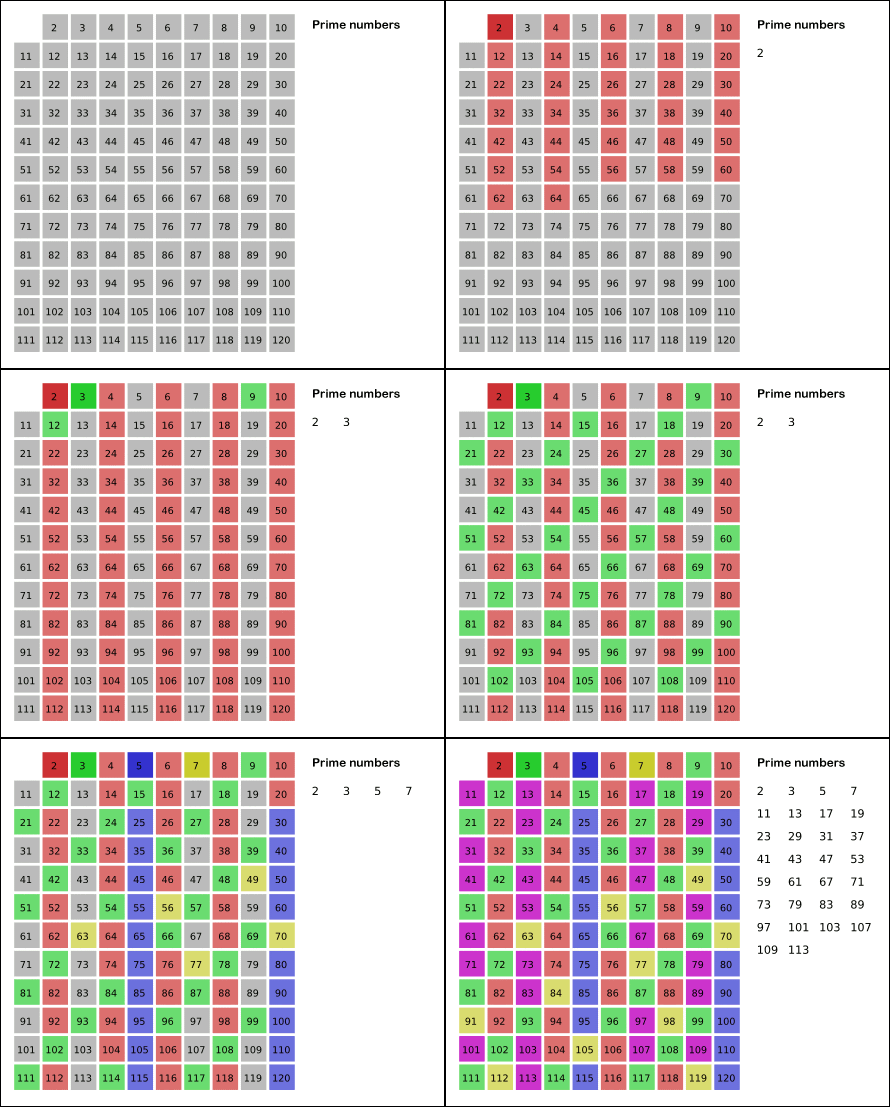
Not too far into my studies in R, I came across Eratosthenes' sieve, a simple algorithm that's often used as an exercise for coding students. What follows is an attempt to unpack one way of coding Eratosthenes' sieve in R, with some help from a friend and some code I found online. I struggled with it a bit myself, which should hopefully put me in the ideal position to explain, since I can remember what confused me (everything), and nothing about it seems obvious to me. 

I'll start with the sieve itself. The point of it is to find all the prime numbers up to a certain point (let's say, up to 100). Starting with 2, what you do is to move through the rest of the numbers crossing out all of the multiples of 2 (since if they're multiples of any other number higher than 1 they can't be prime). Then you do the same with 3, 4, and so on, until you can't do it anymore, since all the multiples of the number you started with have already been crossed out (as multiples of an earlier number). Then you can look at all the numbers that haven't been crossed out. Those are your primes. 


I guess it makes sense as an exercise for beginner coders because it's a pretty easy to understand algorithm, a set of steps for a brain or computer to work through to get a set of outputs (here, prime numbers).


So - as previously advertized - below is one way of getting the R programme to become, for a thrilling and infinitely repeatable moment, the head librarian of Alexandria. After the code itself I'll break it all up into bits, accompanying each bit with some comments that hopefully a) are correct and b) help you understand what's going on. Code is bold, the commentary (a highly Alexandrian form) not. The commentary is talking to R and telling it what to do (imperative mood).


sieve <- function(n) {   
if (n < 2) return(NULL) 
  a <- rep(T, n) 
  a[1] <- F 
  for(i in seq(n)) { 
    if (a[i]) { 
      j <- i * i 
      if (j > n) return(which(a)) 
      a[seq(j, n, by=i)] <- F 

   }
  }
}

sieve <- function(n) { 
Make "sieve" a function that does the below to a number we'll call "n." (This just names our algorithm and makes it a function, a way of doing things to what's in the brackets that follow).

if (n < 2) return(NULL) 
a <- rep(T, n) 

If n is smaller than 2 then spit out NULL. (In other words, refuse to do this computation if it's on a number of numbers less than 2).

Make a vector called "a" and store in it n repetitions, all marked "true." (T stands for 'true.' This is like writing out the number in the grid above. Saying they're all true effectively means we're starting with the assumption that they're all prime.)

a[1] <- F 
Store the first item as false in "a." (Because we want to get rid of 1 immediately?)

for(i in seq(n)) { 
Start with i = 1, iterating the code between here and the closing }, incrementing by one each time, until i = seq(n). (Note the opening curly bracket. The code within the for loop, contained between the curly brackets, will run a number of times equal to the number of elements in seq(n), starting with i = 1, and with the value of i increasing by one each time it runs.)

if (a[i]) { 
If a[i] is true, the code within the ensuing curly brackets will execute. If a[i] is false, it won't. (So if an individual number is false, it won't run the code. At this point that's just 1, as specified above, so I think this just stops R running this algorithm with the number 1. That's actually important, because if it did it would cross off all the numbers and we wouldn't get any primes; another way of looking at this is that being a multiple of 1 doesn't mean a number isn't a prime, and the algorithm needs to recognize this.)

j <- i * I
This finds the square of i and stores it in variable j. Remember we're in the for loop, with incrementing each time the loop repeats. The first time round i = 1 and j = 1; the second, i = 2 and j = 4; the third, i = 3 and j = 9; and so on.

 if (j > n) 
If (and only if) the square of i is greater than the number of elements in the entire sequence...(i.e. that number times itself is larger than e.g. 100...)

return(which(a)) 
Return the sequential positions of all those numbers in a which are true (T). (The idea here is that if we've reach a number whose square is greater then the number of numbers in the sequence, e.g. 100, then we've found all the primes already. I guess this is just a separate assumption that happens to be true?)

a[seq(j, n, by=i)] <- F 
Mark as F (false, i.e. not prime - in other words, cross out) all the numbers in a between the jth and nth (the nth being the last) that are divisible by (that's what 'by' does) i (and thus aren't prime). This line is the heart and soul of the code, the steely essence of Beta's colander. 

OK, I'm still not sure I understand all of that, so if you want to try to help out in the comments be my guest. 

Friday, 1 May 2020

The Rediscovery of Johnny Baloney

Another thing it turns out I'm ignorant about (although I might have suspected it) is the short-lived but spectacular flowering of cast-bronze sculpture in southern Germany around 1600. This took place mainly in Munich, seat of the Wittelsbach princes, and Augsburg, home of the HNW Fuggers - no coincidence, since casting large-scale sculptures is bronze is enormously expensive. The 'Neptune ...taming a sea-horse...which Claus of Innsbruck cast in bronze for me' that the speaker of Robert Browning's 'My Last Duchess' draws his guest's attention towards is supposed to speak loudly about his spending-power. It's also a quiet reminder of a river of artistic influence on which bronze deities of all sorts flowed between northern Italians states and southern German ones as the 16th century drew to a close. 

At the head of this river was a Dutchman, usually known by the less than compellingly Dutch name Giambologna (French Jean de Boulogne). A portrait of him by Hendrick Goltzius (more convincing Dutch name) is above, partly so that he'll stand at the head of a river of images in this post. And partly as a thanks for leading, directly or indirectly, to the flood of monumental bronzes that visitors to Munich can now wade into. 

There's at least one weighty tome on this topic by others who know vastly more about it than I do. So instead of trying to write anything much about it, here's a quick intro in images.

Let's start with two works by Giambologna himself, both on classical themes: the Rape of the Sabines (1574-82) and Hercules and Nessus (1599), both now in the Loggia dei Lanzi in Florence.


Literal tonnes of smaller bronze versions of these are around (including in a room in the Bayerisches Staatsmuseum  in which my personal rediscovery of Johnny Baloney was made). Some are better than others; here are two chosen at random:
One bronze in Munich that is by Giambologna himself is the towering crucifix in Michaelskirche, a gift to the Wittelsbachs by their fellow jet-setters the Medici. There was a connection there, with Albrecht V of Bavaria's sister-in-law marrying Francesco de Medici in 1565. And, of course, their wedding forged a link in the bronze-casting chain, with Hubert Gerhard, a student of Giambologna,  going on to work for both the Fuggers in Augsburg and the Wittelsbachs in Munich. Here are two examples of his efforts, the archangel Michael defeating Lucifer on the facade of the Michaelskirche, and Perseus holding up the head of Medusa (this one in the Wittelsbachs' Residenz palace in Munich):


Soon the Wittelsbachs decided to breed their own sculptors by sending talented sons of Bayern to Florence. Two of the most successful of the new crop were Hanses Reichle and Krumper. Here's another Michael by the one Hans, above the entrance to the Zeughaus in Augsburg; and the tomb monument of the Holy Roman Emperor Louis IV (a Wittelsbach) by the other Hans, in the Munich Frauenkirche:


I've saved probably the most recognizable of Giambologna's works for last, the Flying Mercury from around 1580. This one has been extensively copied and played off, and has turned up all over Europe - including, of course, in the Wittlesbach's home in Munich. What better image of the swiftness and borderlessness of artistic influence could there be?


Friday, 17 April 2020

Epic drop


A few months ago, it was announced that Oxford is proposing to drop Homer's Iliad and Vergil's Aeneid as compulsory first-year texts. I found this particularly interesting, since I did Classics at Oxford, and hence studied the two texts in question in my first couple of terms. In fact, though by the time I started college (2002), I don't think we were required to read the whole of the Aeneid in Latin (only 8 books out of 12, if memory serves), the whole of the Iliad in Greek was still compulsory. I believe that requirement was watered down as well the following year, to 22 books out of 24. I'm thus one of the last hundred or so people to have read the whole of the Iliad at Oxford in my first term (and the following vacation - I have a bittersweet memory of working through Hector and Achilles' duel on Christmas Day). And I'm definitely among a dwindling number of people anywhere who've read the whole thing in the original. Looking back, I feel quite ambivalent about the whole experience, as I do about my degree as a whole.

First off, it's worth pointing out how unusual it is to read that much Greek these days. Even when I was doing my PhD exams in the US, we weren't asked to read either of the Homeric epics complete, only a few books. Some European Classics undergraduates from outside of Oxford will have read that much by the time they finish their first degrees, but not many, and North American Classics majors will be lucky to have read more than a couple books all the way through in Greek. Is this a boast? In part, yes. Reading the whole of the Iliad through took me a lot of time and effort - at least an hour a day for months. It did give me a deeper experience of the work; nothing quite brings home the futility and horror of war like reading through endless descriptions of pitiless bronze slicing through people's limbs. But it was also frustrating and deeply stupid.

That is, the way we were asked to do it was. One of the problems with Oxford's Classics course is that it's still slowly coming down from a 19th-century high in which it could be taken for granted that anybody embarking upon it would have spent the lion's share of their schooling on learning the living daylights out of Greek and Latin. (My favorite example of just how nuts they went on that is Aldous Huxley's reminiscence of spending a full day every week during his time at Eton just on Greek composition.) In those days, first-year undergraduates probably could just read through Homer without much help. (William Gladstone would later look down on the undergraduates who came after him for being able to have recourse to cribs like lexica - he, of course, improvised his own vocabulary lists, which built character.) Nowadays, things are different, even among the two hundred or so undergraduates who turn up having done A-Level Greek.

I know, since I was one of them. I turned up with an A (the top grade in those days!) and having read Iliad 16 as a set text, and...couldn't really read the Iliad to save my life. I did make use of all the aids I could find - lexica (sorry Gladstone), commentaries, and so on. But Homeric Greek is quite hard, and I still think it makes very little sense to ask first-year undergraduates to read more than half of it on their own. In fact, I'm increasingly convinced of that, since I've been teaching Greek to undergraduates for going on ten years now, and (somewhat to my relief), they find reading Greek hard too. They need a lot of help, and there are a lot of things you might well want to ask about or discuss along the way, so we tend to move through texts quite slowly.

So it might be all to the good to move the Iliad to the second part of the course ('Greats'), where students particularly keen on Homer can work on it with more attention, and with their Greek in a better state. (The old 'Early Greek Hexameter' course would seem to be just the place.) That would also give students more choice in general. There's a macro version of this point that's been ably put by Solveig Lucia Gold: the Oxford Classics course is in general quite narrow compared to North American-style à la carte degrees. I'm definitely among those who think UK degrees could and should become more like that; in the meantime (as Gold notes), both systems have their strengths and weaknesses.

One of the strengths of the European system is that it allows students who want to to specialize much more quickly, and to get a really solid grounding in what they've chosen to study. That's nowhere more evident than in the Oxford 'Literae Humaniores' course, in which reading the Iliad and Aeneid has always been only the first step in a very extensive tour of Greco-Roman culture (especially its literary texts). And if you want a really solid grounding in Greco-Roman culture, it makes an awful lot of sense to start by reading a lot of Homer, who was always seen by subsequent Greeks as both the first and the best of their poets. Homer may not have quite been their Bible or their Koran (though theological readings of Homer were a thing, his text wasn't the Revelation of a monotheistic religion); but he was their Chaucer and their Shakespeare at once. The best comparison is probably to say that he was like Dante for the Italians.

It's also nice, I might add, to read whole works. I don't know if this is a dirty secret, but this is getting to be something that classicists very rarely do, at least at undergraduate level. I know, because I'm one of the instructors failing to get through whole texts in the time allotted to me. But I don't blame myself - it takes time to prepare and discuss these texts, and that means it can be hard to get through even a play in a single, six- or seven-week block of classes. Arguably, though, it does make sense for people getting majors in Greek literature (or even Greek or Classics) to have read one or two works all the way through in the original language by the time they finish.

That, of course, needn't mean it's the Iliad students have to read all the way through. They could read one or two shorter works entire. And shorter works make up most of the rest of Greek literature, including, come to think of it, the Odyssey. Why didn't they make me read the Odyssey in my first term? The conventional answer is that the Iliad was always considered the weightier and greater work in antiquity, and while that may be true, the Odyssey was hardly straight-to-DVD either, at least not to the point of justifying me being made to read 24 books of one epic and 0 of the other.

This brings us to one of the reasons that Oxford has given for proposing this change. The main reason I've seen is that this will make things easier for female students, for a range of reasons. One is that they might be less into all the killing that takes place in the Iliad than the lads. I think that's true - after all, preference for rough-and-tumble play is one of the most well-documented of the many natural differences in interest and disposition between men and women, and that seems to be reflected in differing tastes for things like violent movies. The most I think this argument would justify, though, is for students to be given a choice between the Iliad and the Odyssey. Then students, male or female, could choose to spend their time on what most called to them - the harrowing world of the Iliad, or the magical narratives of the Odyssey.

Oxford's main line of reasoning, though, appears to go as follows. More boys than girls take A-Level Greek and Latin. That's true, especially for Greek, with most of the 200 or so pupils who take A-Level Greek coming from all-male boarding schools (which was also, by the way, the case for me). Because of that, male students will on average have a big advantage in reading through the Iliad and the Aeneid in their first two terms. That's also true. Therefore, the argument runs, we shouldn't make understanding those two epics such a major part of the first phase of the degree ('Mods'). That's where I'm not so sure.

One reason is that if having done A-Level Greek gives you an advantage with Homer and Vergil, it'll also give you an advantage with all the other texts on the course (which has a lot to do with reading Greek and Latin texts). If students from certain schools have already read some Homer, students who haven't could be put at even more of a disadvantage by not having a thorough exposure to these fundamental works at an early stage. Besides, Oxford already has a series of variations of the traditional Classics course for students who've done A-Level Latin but not Greek, Greek but not Latin, or neither.

In the end, I don't really mind whether Homer and Vergil's martial epics remain compulsory for first-year students at Oxford. I don't think it would be a disaster if they didn't, and obviously there are bigger issues out there. But if the proposed change doesn't concern me all that much, some of the reasoning behind it does. In the end, it may be that reading Greek and Latin, like other advanced skills - chemistry, maths, or playing football or an instrument to a high level - is the kind of thing that you get better at if, for whatever reason, you've been able to spend more time on it. To what extent it might make sense to change the requirements of highly competitive training programmes for people who've done less of these things - well, that's a complicated topic, and one best left for another time. But the answer's probably not 'to an infinite extent.'